Linfeng Zhang, De-Ye Lin, Han Wang, Roberto Car, and Weinan E., Phys. Rev. Materials 3, 023804 (2019)
URL: https://doi.org/10.1103/PhysRevMaterials.3.023804
Linfeng Zhang, De-Ye Lin, Han Wang, Roberto Car, and Weinan E., Phys. Rev. Materials 3, 023804 (2019)
Abstract An active learning procedure called deep potential generator (DP-GEN) is proposed for the construction of accurate and transferable machine learning-based models of the potential energy surface (PES) for the molecular modeling of materials. This procedure consists of three main components: exploration, generation of accurate reference data, and training. Application to the sample systems of Al, Mg, and Al-Mg alloys demonstrates that DP-GEN can produce uniformly accurate PES models with a minimal number of reference data.
URL: https://doi.org/10.1103/PhysRevMaterials.3.023804
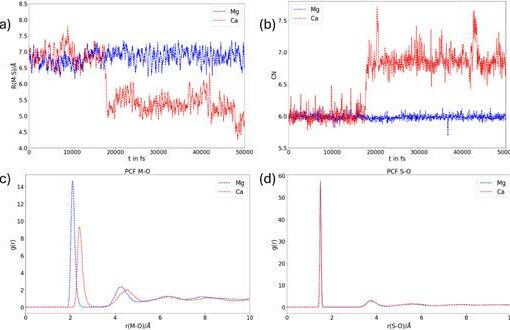
Jan-Niklas Boyn and Emily A. Carter, J. Chem. Phys., 161, 224501 (2024) URL: doi.org/10.1063/5.0235460
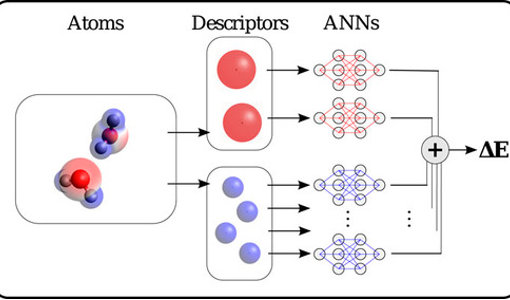
Sebastian Dick and Marivi Fernandez-Serra, J. Chem. Phys. 151, 144102 (2019) URL https://doi.org/10.1063/1.5114618
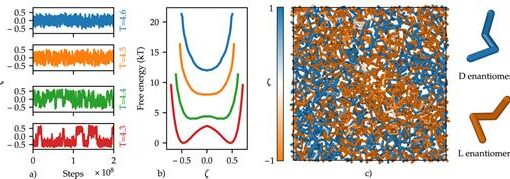
Pablo M. Piaggi, Roberto Car, Frank H. Stillinger and Pablo G. Debenedetti, J. Chem. Phys., 159, 114502 (2023) URL: https://doi.org/10.1063/5.0161732
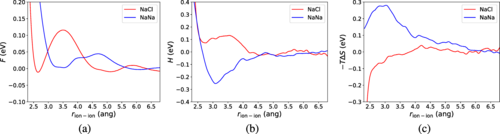
Alec Wills, Anthony Mannino, Isidro Losada, Sara G. Mayo, Jose M. Soler, Marivi Fernandez-Serra, Phy. Rev. Research, 6, 033095, (2024) URL: https://doi.org/10.1103/PhysRevResearch.6.033095